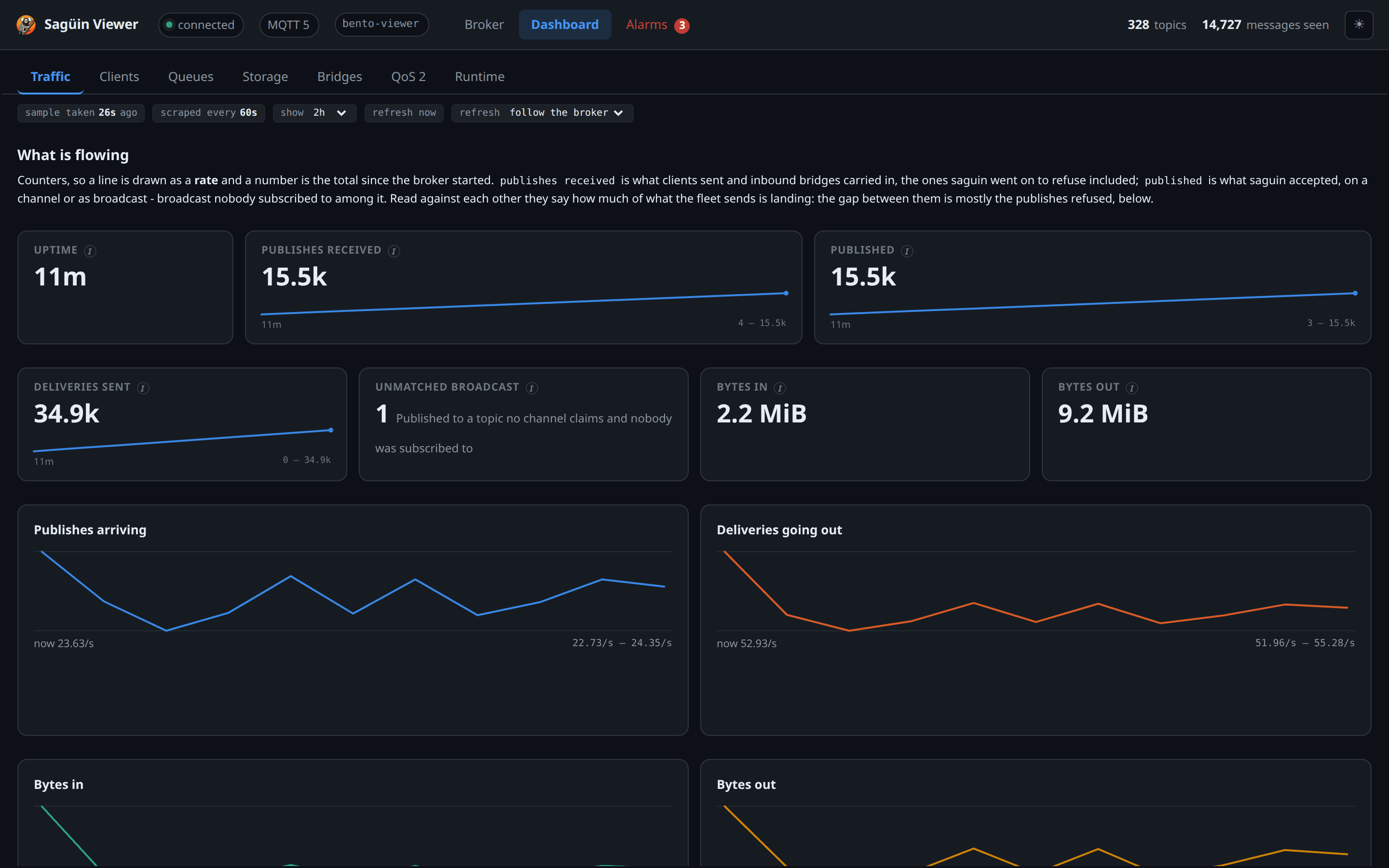
Companion viewerLive broker data
Inspect the claim
Run the system,
not the slide deck.
The repository publishes its design, configuration, metrics and storage documents, the MQTT standards it is tested against, its measurements and runnable examples.
- Guided tourBroadcast, append, latest, queue and storage, with a broker of its own; the full tour adds security, partitioning, refusals, retries and dead letters.
- Home automationTwo stock gateways, zigbee2mqtt and rtl_433, publishing through Sagüin from emulated radio hardware.
- Bento connectorsTwo Bento pipelines moving readings from 200 simulated devices through Sagüin into Kafka.
Measured
100 publishers and 100 durable subscribers at QoS 1, each record going to 10 subscribers, 256-byte payloads, half the publishers at QoS 0 and half at QoS 1, over loopback with the load tool on the same machine. The store in full mode, every commit synced before it is acknowledged. The checks reported no lost, duplicated or reordered messages in those runs. They do not establish behaviour under every failure.
| Machine | Drive | As fast as the clients can, deliveries/s | Ten minutes at a fixed rate, publications/s kept up | Broker memory at peak |
|---|
| AMD Ryzen 7 260, 16 logical cores, 56 GB | consumer NVMe, ext4 | 165,628 | 12,400, every second | 40-60 MiB |
| AMD A10, 4 cores, 13 GB | SATA SSD, Btrfs, copy-on-write off | 31,794 | 2,000, every second | 47-91 MiB |
| Raspberry Pi 4 Model B, 4 ARM cores, 4 GB | SSD over USB, ext4 | 14,975 | 1,100, every second | 47-54 MiB |
On the two four-core machines the broker shared its cores with the load tool, and one store writer’s CPU was the limit. On the Ryzen, a backlog of 1,000,000 QoS 1 publications for away subscribers drained at 83,424 to 86,898 a second when they returned. What it does not establish is a capacity. These are single runs of one recipe, on these machines; make load runs the same recipe on your own hardware.